Geography Class 34
Discussion on the last class (5:12 PM)
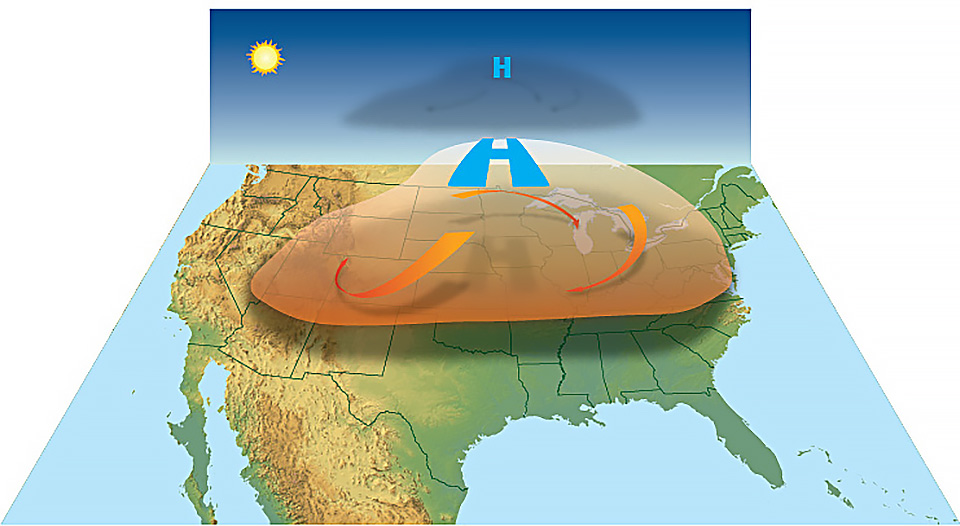
Heat Dome (5:36 PM)
- The phenomena of heat dome that occurred in Canada and the USA in 2021.
- It occurs when the atmosphere traps hot air like a lid
- It is due to when the combined effect of La Nina and weakened Jet streams.
- La Nina results in strong subsidence of hot air, along the eastern pacific.
- Jet streams when weakened start to meander in their path.
- This weakened Jet stream, meandering too much allows the hot air from the tropical region to reach the higher latitude and traps the hot air descending due to La Nina too.
- This results in higher than normal temperatures causing the heat dome.
Tides (6:03 PM)
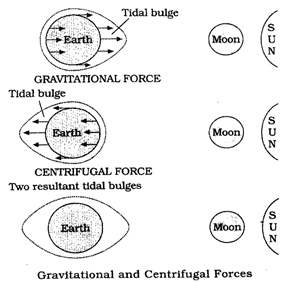
- The regular rise and fall of water levels in the world's oceans resulting from gravitational attraction by the moon and the sun is called Tides.
- The combined gravitational pull of the Sun and Moon pulls the oceanic water in a bulge.
- The centrifugal force due to the earth's revolution pulls another bulge, in the opposite direction.
- The bulges in one direction create low water in another.
- As the earth rotates, the position of high and low waters change across the surface.
- Factors Affecting Tides
- (a) Gravitation pull of Sun and Moon
- (b) Relative position of the Sun and Moon
- (c) Centrifugal force of earth's revolution.
- (d) Uneven distribution of Water
- (e) Ocean Bottom topography
- Types of Tides
- (a) Spring tide
- These are very high, high tide, and very low tides.
- They are experienced when the sun, earth, and moon are in a straight position.
- This is called syzygy
- The conjunction is when the earth, moon, and sun are in E-M-S
- Opposition is when alignment is M-E-S
- (b) Neap tide
- These are smaller high tides and smaller low tides.
- A neap tide is when the sun and moon are in a perpendicular direction.
- The position is called Quadrature.
- The tides which are observed twice a day are called semi-diurnal tides
- Those which are observed once a day are called Diurnal tides.
- Significance of Tides
- (a) Tidal power generation
- (b) It helps in navigation for the tidal ports.
- (c) It helps in fishing activities.
- (d) Helps in maintaining higher biodiversity along the tidal range.
- (e) Helps in the natural cleansing of the coasts.
- (f) It restricts the delta formation, as it doesn't allow the sediments to accumulate.
- (g) At other places it causes coastal erosion.
Maritime Zones (6:42 PM)
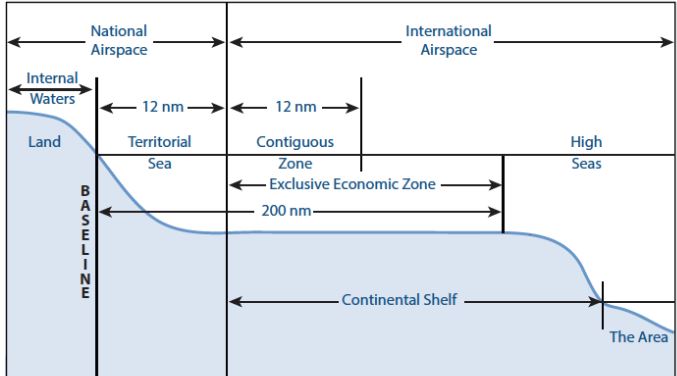
- Baseline
- It is the average line where the land ends and the ocean begins.
- Internal Waters
- It includes all the water bodies along the landward side of the baseline.
- Territorial Sea
- It is 12 nm from the baseline.
- A country exercises sovereign jurisdiction on the bottom, surface, and air. However, innocent passage is allowed with restrictions.
- Contiguous Zone
- It is up to 24 nm from the baseline.
- Sovereign jurisdiction over the bottom and surface but not in the air.
- Exclusive Economic Zone
- up to 200 nm from the baseline.
- A country can exploit the resources on the ocean floor.
- It extends beyond 200 nm if the continental shelf crosses it.
- It will be allowed till the edge of the continental shelf.
- High seas
- International waters come under International Seabed Authority.
Biogeography (7:12 PM)
- It is the study of the soil in relation to vegetation.
- Soil
- The loose surface material consists of inorganic and organic matter and is the source of water and nutrients for the vegetation.
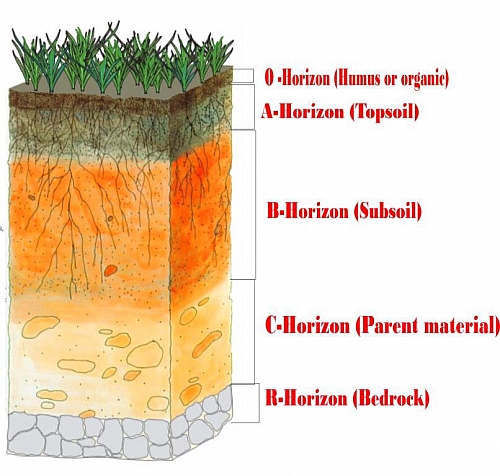
- True soil is characterized by distinct horizons and the capacity to support vegetation.
- Horizon
- Horizon is a distinguishable layer in the soil that has certain chemicals and a distinct colour.
- Regolith
- The layer of unconsolidated materials is derived from weathering of the parent rock.
- Soil Profile
- It is the vertical arrangement of the horizons down to the parent rock material.
Soil Formation (7:45 PM)
- Soil depends on five major factors: Parent rock, climate, organism, relief, and time.
- Parent Rock Material
- It decides the texture, colour, and basic mineral composition of the soil.
- For Example Quartzite rocks, result in a sandy texture.
- However, the role of the parent rock decreases with time.
- Climate
- It is the most dominant factor which affects the soil directly, by controlling weathering, percolation, and other processes.
- It results in the development of different horizons.
- Organisms
- Plant roots, burrowing animals, and microorganisms help in loosening up the soil and better air and nutrient circulation.
- Relief
- It determines the thickness of the soil.
- Time
- It controls the other factors and determines the maturity of soil.
- Soil Formation Processes
- Transformational Process
- The change of soil constituents from one form to another through breakdown, weathering, decay, etc.
- Translocational Process
- It involves the movement of soil constituents from one horizon to another within the soil profile.
- Eluviation: The downward transport process through which the minerals are removed from the top layer
- Illuviation: It is the reverse of eluviation, in which matter accumulates in the lower horizon.
- Leaching: the percolating water removes humus and the soluble bases from the upper horizon and deposits them in the lower horizon through the process of leaching.
- Leaching is more active in humid regions.
The Topic for the next class: Soil (continued), Mapping, and Indian Geography.